Sunday, May 10, 2015

Unit 7


Balance of payments
Measure of money inflows and outflows between the United States and the rest of the world (ROW) 

  • Inflows are referred to as credits
  • Outflows are referred to as debits

The balance of payments is divided into 3 accounts

  • Current account
  • Capital/financial account
  • Official reserves account

Double entry bookkeeping

  • Every transaction in the balance pf payments is recorded is recorded twice in accordance with standard accounting practice
  • Ex. U.S. manufacturer, John Deere, exports $50 million worth of farm equipment to Ireland. 
  • A credit of $50 million to the current account (- $50 million worth of farm equipment or physical assets)
  • A debit of $50 million to the capital/financial account (+$50 million worth of euros or financial assets)

Current account

Balance of trade or net exports

  • Exports of goods/services - import of goods/services
  • Exports create a credit to the balance of payments
  • Imports create a debit to the balance of payments

Net foreign income 

Income earned by U.S. owned foreign assets - income paid to foreign held by U.S. assets

Ex. Interest payments on U.S. owned Brazilian bonds - interest payments on German owned U.S. Treasury bonds

Net transfers (tend to be unilateral) 

Foreign aid > a debit to the current account

Ex. Mexican migrant workers send money to family in Mexico

Capital/financial accounts

The balance of capital ownership

  • Includes the purchase of both real and financial assets
  • Direct investment in the United States is a credit to the capital account
  • Ex. The Toyota factory in San Antonio
  • Direct Investment by U.S. firms/individuals in a foreign country are debits to the capital account
  • Ex. The Intel factory in San Jose, Costa Rica
  • Purchases of foreign financial assets represents a debit to the capital account
  • Ex. Warren Buffet buys stock in Petrochina
  • Purchases of domestic financial assets by foreigners represents a credit to the capital account
  • The United Arab Emirates sovereign wealth fund purchases a stake in the NASDAQ
Relationship between Current and Capital account
Remember double entry bookkeeping?
  • The current account and the capital account should zero each other out
  • That is...if the current account has a negative balance (deficit), then the capital account should have a positive balance (surplus). 

Official reserves
  • The foreign currency holdings of the United States Federal Reserve System
  • When there is a balance pf payments surplus the Fed accumulates foreign currency and debits the balance of payments

Active vs passive official reserves

  • The united states is passive in its use of official reserves. It does not seek to manipulate the dollar exchange rate.
  • The people's republic of china is active in its use of official reserves. It actively buys and sells dollars in order to maintain a steady exchange rate with the united states. 
  • Foreign exchange (FOREX)
  • The buying and selling of currency
  • Ex. In order to purchase souvenirs in France, it is first necessary for Americans to sell (supply) their dollars and buy (demand) Euros.
  • The exchange rate (e) is determined in the foreign currency markets.
  • Simply put. The exchange rate is the price of currency. 
  • Do not try to calculate the exact exchange rate. 

Tips

  • Always change the demand line on the currency graph, the supply line on the other currency's graph.
  • Move the lines of the two currency graphs in the same direction (right or left) and you will have the correct answer. 
  • If D on one graph increases, S on the other graph decrease
  • If D moves to the left, S will move to the left on the other graph. 

Changes in Exchange Rates

  • Exchange rates (e) are a function of the supply and demand for currency. 
  • An increase in the supply of a currency will make it cheaper to buy one unit of that currency. 
  • A decrease in supply of a currency will make it more expensive to buy one unit of that currency
  • An increase in demand for a currency will make it more expensive to buy one unit of that currency
  • A decrease in demand will make it cheaper to buy one unit of that currency. 
  • Appreciation of a currency occurs when the exchange rate pf that currency increases (e ^)
  • Hypothetical: 100 yen is used to buy $1. Now 200 yen buys $1
  • The dollar is "stronger"
  • Depreciation of a currency occurs when the exchange rate of that currency decreases (e decreases)
  • One hundred yen used to buy one dollar. Now 50 yen buys one dollar
  • The dollar is weaker because it takes fewer yen to buy the dollar.

Exchange rate determinants

Consumer tastes

  • Ex. A preference for Japanese goods creates an increase in the demand of yen and an increase in the supply of dollars in the currency exchange market.
  • The increase in demand of the yen leads to the appreciation of the yen.
  • The increase in the supply of dollars leads to the depreciation of the dollar. 

Relative income

  • Imports tend to be normal good
  • Ex. If Mexico's economy is becoming stronger and the U.S. Economy is in recession, then Mexicans will buy more American goods.

Relative price level
  • Ex. If the price level is higher in Canada than in the United States, then American goods are relatively cheaper than Canadian goods. 
  • This Canadians will import more american goods causing the us dollar to appreciate. 

Speculation

  • Ex. If Us investors expect that Swiss interest rates will climb in the future, then Americans will demand Swiss francs in order to earn the higher rates of return in Switzerland. 
  • This will cause the Swiss franc to appreciate as demand for it will increase. 
  • Supply of the dollar will increase causing it to depreciate. 

Thursday, May 15, 2014

Dreams


Manifest Content: the remembered storyline of a dream.
Latent Content: the underlying meaning of a dream
Why do we dream?
Freud's wish-fulfillment Theory
*dreams are the key to understanding our inner conflicts.
* idea and thoughts that are hidden in out unconscious
* manifest and lantent content
Information-processing Theory
*Dreams act to sort out and understand the memories that you experience that day.
* REM sleep does increase after stress event.
Physiological function theories
that studies the soul, the mind, and the relationship of life and mind to the functions of the body
Activation-synthesis Theory
* during the night our brainstem releases random neural activity, dreams may be a way to make sense of that activity

Wednesday, May 14, 2014

Sleep disorders

Insomnia
* persistent problems falling asleep
* affects 10% of the population
Narcolepsy
* suffer from sleeplessness and may fall asleep at unpredicatble or inapporpriate times.
* directly into REM sleep
* less than .001% of the population


Sleep Apnea
* a person stops breathing during their sleep.
* wake up momentarily, gasps for air then falls back asleep.
* very common, especially in heavy males
Night Terrors
*sleep disorder characterized by high arousal and an appearance of being terrified.
* Occur in stage 4 not REM, and are not often remembered
Sleepwalking (somnambulism)
* sleepwalking is a sleep disorder afftecting an estimated 10 % of all humans at least once in their lives.
* sleep walking most often occur during deep non-REM sleep (stage 3 or stage 4 sleep) early in the night.

Wednesday, May 7, 2014

State of Consciousness

SleepHypnosis
Drugs

Sleep
*Sleep is a state of consciousness
* we are less aware of our surrounding
Consious, Subconscious, Unconscious
Why do we daydream
* they can help us prepare for future events.
* they can nourish our social development
* can substitute for impulsive behavior
Fantasy Prone Personalities
* someone who imagines and recalls experiences with lifelike vividness and who spends considerable time fantasizing.
Biological Rhythms
Annual cycles: seasonal variations (bears hibernation, seasonal affective disorder)
28 day cycles: menstrual cycle.
24 hour cycle: our circadian rhythm.
90 minute cycle: sleep cycles.
Circadian Rhythm
*our 24 hour biological clock.
* our body temperature and awareness changes throughout the day.
* it is best to take a test or study during your circadian peaks.
Sleep Stage
* There are 5 identified stages of sleep.
* takes about 90-100 to pass through all 5 waves
* the brain's waves will change according to the sleep stage you are in
* the first five stages are known as NREM sleep.
* the fifth stage is called REM sleep.
Stage 1
*kind of awake and kind of asleep.
* only lasts a few minuets and you usually only experience it once a night
* eyes begin to roll slightly
* your brain produces theta waves ((high amplitude, low frequency (slow))
Stage 2
* this follows stage 1 sleep and is the "baseline of sleep".
* this stage is part of the 90 minuet cycle and occupies approximately 45-60% of sleep.
* more theta waves that get progressively slower
Stage 3
* slow wave sleep
* you produce Delta waves
* if awoken you will be groggy
* vital for restoring body's growth hormones and good overall health.
Stage three & four
*may last 15-30 minuets
* it is called "slow wave" sleep because brain activity slows down dramatically from the "theta" rhythm for Stage 2 to a much slower rhythm called "delta" and the height or amplitude of the waves increases dramatically
Stage Three and four
* contrary to popular belief, it is delta sleep that is the "deepest" stage of sleep (not REM) and the most restorative
* it is delta sleep that a sleep-deprived persons brain craves the first and foremost.
* in children, delta sleep can occupy up to 40% of all sleep time and this is what makes children unworkable or "dead asleep" during most of the night.
REM Sleep
* rapid eye movement
* often called paradoxical sleep
* brain is very active.
* dreams usually occur in REM sleep.
* body is essentially paralyzed.
Stage T: REM SLEEP
* composes 20-25% of normal nights sleep.
* breathing, heart rate and brain wave activity quicken.
* vivid dreams can occur.
* from REM, you go back to stage 2

Tuesday, May 6, 2014

Ratio Schedules

Operant conditoning
* takeing away things
* response
Classical conditioning
* stimulus occured before the behavior
Reinforcement , used to increase a desired behavior
Punishment, used to decrease a unwanted behavior
Fixed Ratio
* provides a reinforcement after a set number of responses
Variable ratio
*
Interval Schedules
Fixed interval
* requires a set amount of time to elapse before giving the reinforcment
Variable interval
*requires a random amount of time to elapse before giving the reinforcement
*very hard to get acquisition but also very resistant to extinction.
Observational Learning
*Albert Bandura
BoBo doll
* we learn through modeling behaviot from others.
*Obeservational learning + Operant conditioning= social learning Theory
Laten learning
* Edward Toleman
* Three rat experiment
* Latent means hidden.
*sometimes learning is not immeditate
Insight Learning
* wolfgang Kohler and his chimpanzees.
* some animals learn though the "ah ha" experience.

Monday, May 5, 2014

Operant Conditioning

The learner is NOT passive. Learning based consequence!!
Operant Conditioning
*a type of learning in which behavior is strengthened if followed by reinforcement or diminished if followed by punishment
Classical v. Operant
* They both use acquisitioning, discrimination, SR, generalization and extinenction
* classical conditioning is automatic
*Respondent Behavior)
* dogs automatically salivate over meat, then bell no thinking involved
* operant conditioning involves behavior where one can influence their environment with behaviors which have consequences
Operant behavior
The Law effect
* Edward Thorndike
Rewarded behavior is likely to recur.
B.F Skinner
shaping
* a procedure in operant conditioning in which reinforcers guid behavior closer and cloer towards a goal.
Operant Conditioning Chamber
Reinforcer
* any event that strengthens the behavior it follows
* two types of reinforcement
Positive and negative
Positive Reinforcment
* strengthens a response by presenting a stimulus after a response.
Negative Reinforcement
*strengthens a response by reducing or removing an averive stimulus
Primary Reinforcer
* an innately reinforcing stimulus
Conditioning (secondary) Reinforcer
* a stimulus that gains it reinforcing power through its association with primary reinforcer.
Punishment
* an event that decreases the behaviot that it follows
Continuous Reinforcement
* reinforcing the desired response every time it occurs
Partial Reinforcement
* Reinforcing a response only part of the time
* the acquisition process is slower.
* greater resisitance ro extinction.
Fixed-ratio Schedules
* A schedules that reinforces a response only after a specified number of responses
Variable-ratio Schedule
*a schedule of reinforcement that reinforces a response after an unpredictable number of responses
Fixed-interval Schedual
* a schedual of reinforcment that reinforcment that reinforces a response only after a specified time has elapsed
variable-interval schedule
*a schedule of reinforcement that reinforces a response at unpredictable time interval

Thursday, May 1, 2014

Learning

Most learning associative learning
* learning that certain events occur together

Three main types of learning

*classical Conditioning
* it started with Ivan Pavlov

Unconditioned Stimulus (UCS): a stimulus that naturally and automatically triggers a response

Unconditional Response (UCR): the unlearned naturally occuring response to the UCS

Conditioned Stimulus (CS): An originally irrelevant stimulus that, after association with the UCS, comes to trigger response.

Conditioned Response (CR): the learned response to previously neutral stimulus.

Aquisition
* the Initial stage of learning
* the phrase where the neutral stimulus is associated with the UCS so that the neutral stimulus comes to elicit the CR ( thus becoming the CS )

Extinction
*The diminishing of a conditional response

Spontaneous Recovery
* The reapperearance. After a rest period of an extinuished conditioned response.

Generalization
*The tendency, once a response has been conditioned for stimuli similar to the CS to elicit similar responses.

Discrimination
*the learned ability to dishinguish between CS and other stimuli that does not signal UCS.

Thursday, April 24, 2014

Memory


Encoding
* The process of information into the memory

Storage
* the retention of encoded material over time.
* pressing Crtl S and saving info

Retrieval
* Process of getting the information out of memory storage

Recall v. Recognition
*with recall - you must retrive the information from your memory (fill in the blank test)
*with recognition- you must identify the target from possible targets (multiple-choice test)

Flashbulb Memory
* A clear moment of an emotionally significant moment or event

Types of Memory
* Sensory Memory
* Short term memory

Sensory Memory
*immediate, initial recording of sensory information in the memory system
* stored just for an instant and most gets unprocessed

Short term Memory
* memory that holds a few items breifly
* seven digits (plus of minus two)
*the info will be stored into longer term or forgotten.

Working memory
*antoher way of describing the use of short term is called working memory
* working- memory has three parts
1. Audio
2. Visual
3. Integration of audio and visual (controls where you attention lies)

Long Term Memory
* the relatively permanent and limitless storehouse of the memory system

Automatoc Processing
*unconscious encoding of incidental information
* you encode space, tome and word meaning withour effort
* things can become automatic with practice

Effortful Processing
*Encoding that requires attention and conscious effort
*Rehearsal is the most common effortful processing technique
* Through enough rehearsal, what was effortful become automatic

Next in line effect
* we seldom remember what the person has just said or done if we are next

Spacing effect
* we encode better when we study or practice over times
* DO NOT CRAM!!

Serial Postioning effect
* Our tendency to recall best the last and first items in a list.

Types of encoding
* semantic encoding : the encoding of meaning like the meaning of words

* acoustic encoding: the encoding of sound, especially the sounds of words

* visual encoding: the encoding of picture images

Tricks to Encode
* Use Imagery: mental pictures
Mnemonic Devices use Imagery. Like my "peg word" system or...

Chunking
* Organizing items into familiar manageable units

TYPES of LTM
* Explicit
(With conscious recall
* fact-gerneral knowledge
* Personally experienced events

Implicit
* with out concious recall
* skulls motor cognitive
*classical and operant conditioning effects

Types of Retrieval Failure
Proactive Interference
*the disruptive effect of prior learning on the recall of new information

Types of Retrieval failure
*Retroactive Interference
* The disruptive effect of new learning on the recall of old information.

Misinformation Effect
*incorporating misleading information into ones memory of an event

Thursday, April 10, 2014

Sensation

Touch
* receptors located in our skin
* Gate Control Theory of Pain
* the spinal cord a neuralogical gate that blocks, pain signals, or allows them to pass on to the brain

Vestibular Sense
* tells us where our body is oriented in spac
*Our sense of balance

Kinesthetic Sense
* Tells us where our body parts are.
* Receptirs locate in our muscles and joints.

Perception
* the process or organizing and interpreting information, enabling us to recognize meaningful objects and events.

Gestalt Philosophy
* the whole is greater than the sum of its parts

Figure Ground Relationships
* The organization of the visual field into objects (figures)
That stand out from their surroundings

Grouping
* The perceptual tendency to organize stimuli into groups that we understand

Depth Perception
* the ability to see objects in three dimenstions although the images that strike the retina are two dimesional
* allows us to judge distance

*visual cliff

Binocular Cues
* Rentinal Disparity: a binocular cue for seeing depth
* the closer an object comes to you the greater the dispairty is between the two images

Wednesday, April 9, 2014

Transduction Continued

Order is Rods/Cones to Bipolar to Ganglion to Optic never

Paralle processong

Color vision
* Three types of cones
* red
*blue
*green
* these three types of cones can make millions of combinations of colors.
*most colorblind people simply lack cone receptor cells for one or more of these primary

Opponetnt-Process theory
*the sensory receptors
*red/green
*yellow/blue
*black/white
* if one color is stimulated

Hearing
*the height of wave gives us the amplitude of the sound
* the frequency of the wave gives us the pitch of the sound

The Ear

Transductions in the ear
* sound waves hit the eardrum
Then anvil then hammer then
Stirrup then oval window
* everything is just vibrating
* then the cochlea viberates
* the cochlea is lined with mucus called basilar membrane.
* in basilar membrane there are hair cells.
* when hair cells vibrate they turn vibrations into neural impilses which are called organ of Corti
* sent then to the thalamus up auditory nerve

Pitch theory
Place theory
* different hairs vibrate in the cochlea when there are different pitches.
*so some hair vibrate when they hear high pitches and other viberate when they hear low pitches.

Frequency Theory
* all the hairs vibrate but all different speeds.

Deafness
Conduction Deafness
* something goes wrong with the sound and the vibration on the way to the cochlea
* you can replace the bones or get hearing aid to help

Nerve (sensorineural) Deafness
* the hair cells in the cochlea get dammaged
* loud noises can cough this type of deafness
*NO WAY to replace the hairs
* cochlea implant is possible

Smell and Taste
* Sensory Interaction: the princeple that one sense may influence another.

Taste
* we have bumps on our tongue called papillae
* Taste buds are located on the papillae ( they are actually all over the mouth*
*sweet, salty, sour, and bitter, hot spicy,
*bitter
*sour
*salty
*sweet
UMAMI- flavorful, meaty, saviory taste pollo asido

Thursday, April 3, 2014

Types of intelligence

Crystallized Intelligence
* Accumulated knowledge.
* Increases with age.
Fluid Intelligence
* Ability to solve problems quickly and think abstractly
* peaks in the 20's then decreases over time
Moral Development
* Three Stage Theory by Lawrence Kohlberg!!
Pre-Conventional Morality
* morality based on rewards and punishments
* if you were rewarded then it is OK.
* If you are punished, the act must be wrong.
Conventional Morality
*Look at morality based on how others see you
* if your peers, or society, thinks it is wrong, then so do you.
Post-Conventional Morality
* Based on self-defined ethical principles
* your own personal set of ethics.

Wednesday, April 2, 2014

Schemas


Schemas
* children view the world through schemas ( as do adults for the most part)
* schemas are ways we interpret the world around us
* it is basically what you picture in your head when you think of anything
Assimilation
* incorporating new experiences
Accommodation
* changing an existing schema to adopt to new information
Stages of cognitive development
* sensorimotor stage
0-2
* experiences the world through our senses
* do not have object permanence
Preoperational Stage
2-7
* have object permanence
* begin to use language to represent objects and ideas
* Egocentric: cannot look at the world through anyones eyes but their own.
Conservation
* conservation refers to the idea that a quantity remains the same despotr changes in appearance and Is part of logical thinking.
Concrete Operational Stage
* can demonstrate concept of conservation
* learn to logically
Formal Operational Stage
* abstract reasoning
*manipulate objects in our minds without seeing them
* hypothesis testing
* trial and Error
* metacognition
* not every adult gets to this stage

Tuesday, April 1, 2014

Reflexes

* inborn automatic responses
*rooting, tendency, when touched by the cheek to open mouth and search for the nipple
*sucking
*grasping
*moro
*babinski

Maturation
* physical growth regardless of environment

Puberty
* the period of sexual maturation during which a person becomes capable of reproducing.

Primary Sexual Characteristics
* Body structure that make reproduction possible.
* penis, testes, vagina ovaries

Secondary sexual Characteristics
* Non-reproductive sexial chracteristics
Females- widening of the hips, breast development
Males- hair, and deeper voice
Landmarks for puberty
* Menarche for girls
*first ejaculation for boys (spermarche)

Physical Milestone
* Menopause, they can't have children, no period

Death
* Elizabeth Kubler-Ross's
Stages of Death/Grief
1. Denial
2. Anger
3. Bargaining
4. Depression
5. Acceptance

Social Development
* at about a year, infant develp Stranger anxeity.
* display anxiety.
* seperation anxeity-  seperation leaves sociological promblems

Attachment
* Harry Harlow and his monkeys .
* Harry showed that Monkeys needed touch to form attachment.

Critical Periods: the optimal period shortly after birth when an organisms exposure to certain stimuli or experiences produced proper development.
* those who are deprived of touch have a trouble forming attachment when they are older

Types of Attachment
Mary Ainsworth strange situation.
1. Secure
2. Avoidant
3. Anxious/ ambivalent

Parenting Styles
* Authoritarian Parents - parents are the boss
* Permissive Parents. - the kids are in charge
* Authoritative Parents - parents and kids compromise

Erik Erikson
* A neo-Freudian
* worked in Anna Freud
* though our personality was influenced by our experienxes.

Trust vs. Mistrust
0-2 years of stage
* can a baby trust the world to fulfill its needs"
* the trust or mistrust they develop can carry on with the child

Autonomy V. Shame & Douby
* Toddlers begin to control their bodies (toilet training)
* control Temper Tantrums
* "No"
* can they learn control or will they doubt themselves.

Initiative V. Guilt
* Word turns from "No" to "why"
* want to understand the world and ask questions.
* is there curiousity encouraged or scolded

Industry V. Inferiority
* school begins
* we are for the first time evaluated by a formal system and our peers.
* do we feel good or bad about accomplishments?
* can lead to us feeling bad about ourseleves for the rest of our lives... inferiority complex.

Identity C. Role Confusion.
* In our teenage years we try out different roles.
* who am I?
* what group do I fit in with?

Intimacy V. Insolation.
* have to balance work and relationships.
* what are my priorities?

Generativity V. Stagnation
* is everything going as planned?
* am I happy with what I Created.
* Mid-Life crisis

Integrity V. Despair
* Look back on life
* was my life
meaningful or do I have regret?

Cognitive Development
* it was though that kids were just stupid versions of adults.
* then came along Jean Paiget
* kids learn differently than adults.

Thursday, March 20, 2014

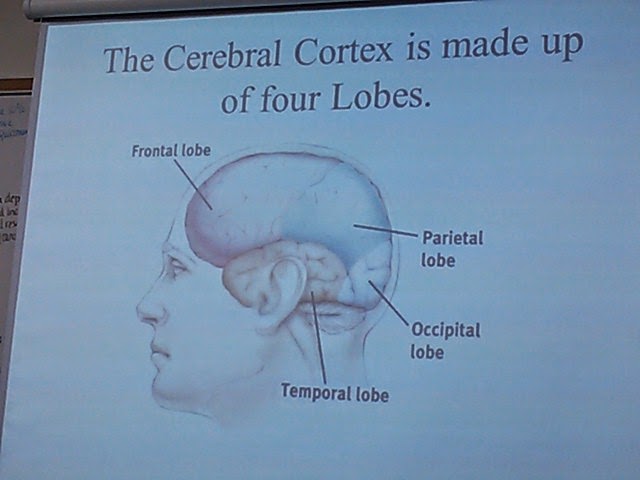
The Cerebrat Cortex is made up of four lobes

Frontal Lobe, Parietal Lobe, Occipital Lobe, and Temporal Lobe
Frontal Lobe
*Abstract thought emotional control
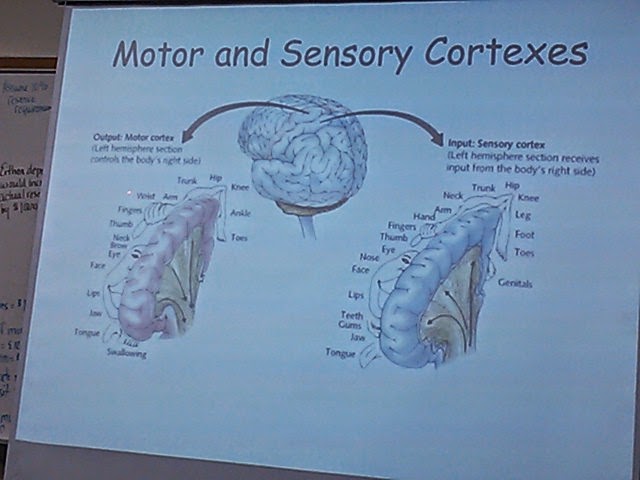
*Containes Motor Cortex: sends signals to our body controlling muscle movements
*Broca's: Responsible for controlling muscles that porduce speech
* Damage to Broca's Area is called Broca's Aphasia: unable to make movments to talk
Parietal Lobes:
*Contain sensory cortex: receives incoming touch sensations from the rest of the body
* Most od the parietal lobes are made up of Association Areas
Assiociation Areas:
* any area not associated with receving sensory information of coordinating muscle movements.
Occipital Lobes
* deals with vision contains Visuals Cortex.
*interperts messages from our eyes into images we can understand.
Temporal Lobes
* Process sound sensed by our ears.
* Interpreted in audiory cortex
* NOT LATERALIZED
* Contains Wernike's Area: interprets written and spoken speech.
* Wernike's Aphasia: unable to understand language: the syntax and grammar jumbled.
Endocrine System
*System of glands that screte hormones.
*similar to nervous system except hormones work a lot slower than neurotansmitters.
Hypothalamus: (brain region controlling the pituitary gland)
Thyroid gland: affects metabolism among other things
Pituitary Gland: Secretes many different hormones, somes of which affects other gland
Parathyroids:(help regulate the level of calcium in the blood)
Adrenal Glands:( inner part called the medulla, helps trigger the "fight or flight" response
Pancreas: regulates the level of sugar in the blood
Testis: male sex hormones
Ovary: femal sex hormones

Monday, March 17, 2014

Cerebellum

* Located in back of our head-means little brain.
*coordinates muscle movements
*like tracking target

Thalamus
* In Forebrain
* Receives sensory information sends them to appropriate areas of forebrain.
* Like a switchboard.
* Everything but smell

Limbic System
* Emotional control center
* Made up of hypothalamus, Amygdala and Hippocampus

Hypothalamus
* Pea sized in brain but plays a not so peasized role.
* Body temperature
* Hunger
* Thirst
* Sexual Arousal (libido)

Hippocampus and Amygdala
* Hippocampus- is involved in memory processing
*Amygdala- is vital for our basic emotions

Cerebral Cortex
* Top layer of our brain
* Containes wrinkles called fissures increases surface area of our preain.
* Laid out it would be about the size of a large pizza

Hemisheres
* divided into a left and right hemispher
*a contralateral controlled left controls right side of bodt and vice versa
* Lefties are better at spatial and creative tasks
* righties are better are better at logic

Split-Brain Patients
* Corpus Collosum attaches the two hemispheres of cerebral cortex
*when removed you have a split-brain patient.

Thursday, March 6, 2014

Biological School

The Nervous System
* it starts with an individual nerve cell called a NEURON
Neuroanatomy
Neurotrainmitters (chemicals held in terminal buttons that travel through synaptic gap)
Terminal branches of axons (form junctions with other cells)
Cells body (the cels life support center
Dendrites (receive messages from other cells)
Axon (passages message away from the cell body to other neurons muscles or glands)
Myelin sheath (covers the axon of some neurons and helps speed neural impulses
Neural impulse ( electrical signal traveling down the axon)
Synapse allows a electrical singel to pass to another cell
How does a neuron fire
* Resting Potential:
* slightly negative charge
*Reach the threshold when enough neurotranmitters reach dendrites
Its a eletrochemical process
* Electrical inside the neuron
* Chemical outside the neuron (in the synapse in the form of a neurotransmitter).
* The firing is call Action Potential.
The All or None Response
* the idea that either the n
Neurotransmitters
* Chemical messengers released by terminal buttons through the synapse.
* we should know atleast 4 types
Acetylcholine (ACH)
* Deals with motor movement and memory.
*too much and you will
* too little and you will
* the lack of ACH been linked to Alzheimer's disease.
Dopamine
* Deals with Motor movements and alertness.
* Lack of dopamine has been linked to Parkinsons disease
* Too much has been linked to Schiophernia.
Serotonin
* Involved in mood control
* Lack of serotonin has been linked to clincial depression
Endorphins
* Involved in pain control.
* many of our most addictive drugs deal with endorphins
Drugs can be....
* Agonists... Make neuron fire
* Antagonists... Stop neural firing
Sensory Neurons
(Afferent Neurons)
*take information from the senses to the brain.
Inter Neurons
* Take messages from Sensory Neurons to other parts of the brain or to motor Neurons
Motor Neurons ( Efferent Neurons)
* take information from the brain to the rest of the body
Central Nervous System
* the brain and the spinal cord
Periheral Nervous system
* all nerves that are not encased in bone
*everything but the brain and spinal cord
*is divided into two categories... somatic and
autonomic.
Somatic Nervous System
*Controls Voluntary muscle movments
*uses motor (efferent) neurons
Autonomic Nervous System
* Controls the automatic functions of the body
*divided into two categories the symapatheic and Parasympathetic
Sympathetic Nervous System
*Fight or flight response
* Automatically accelerates heart rate, breathing, dilates, pupils, slows, down digestion

Monday, March 3, 2014

James-Lange Theory of Emotion

* Experience of emotion is awarness of physiological
responses to emotion arousing stimuli
*sight of oncoming car (perception of stimulus)
* pounding heart (arousal)
*fear (emotion)

Emotion
* We feel emotion because of biological caused by stress.
* The body changes and our mind recognizes the feeling.

Cannon-Bard Theory of Emotion
* Emotion-arousing stimuli simultaneously trigger:
* physiological responses
* subjective experience of emotion

Schachter's Two-Factor Theory of Emotion
* To experience emotion to one must:
* be physically aroused
* cognitively label the arousal

Emotion-Lie Detectors
Polygraph
* machine commonly used in attempts to detect lies
* measures several of the physiological responses accompanying emttion
    * perspiration
    * cardiovascular
    * breathing changes
Experienced Emotion
Catharsis
* emotional release
* catharsis hypothesis
  * "releasing" aggressive enerfy (through action or fantasy) relieves aggressive urges

Feel-good, Do-good Phenomenon
* people's tendency to be helpful when already in good mood.

Adaptation-Level Phenomenon
* tendency to form judgments relative to "neutral" level
  * brightness of lights
  * volume of sounds
  * level of income
* defined by our prior experienced

Relative Dprivation
* perception that one is worse of relative to those with whom one comapres oneself

Achievemnt Motivation

Instrinsic Motivators
* Rewards we get internally such as enjoyment or satisfaction
Extrinsic Motivators
* Rewards that we get for accomplishments from outside ourselves (grades or money or etc..)
Management Theory
Theory X
* Managers believes that employees will work only if rewarded with benefits or threatened with punishments.
* Think employees are Extrinsically Motivated.
* Only interested in Maslows lower need.
Theory Y
* Managers believe that employees are internally motivated to do good work and polices should encourage this internal motive.
* Interested in Maslow's higher needs.

Friday, February 28, 2014

How does Hypothalamus Work

Two Theories
Leptin
* Leptin is a protein produced by bloated fat cells.
* hypothalamus senses reises in leptin and will curb eating and increase activity
*can leptin injections help me?
Set Point
* Hypothalamus acts like a thermostat.
* We are meant to be in a certain weight range
*when we fall below weight our body will increase hunger and decrease energy expenditure (Basic Metabolic Rate)
Body Chemistry
* Glucose
* The hormone insulin converts glucose to fat.
* When glucose levels drop-hunger increases.
Hypothalamus & Hormones

* the hypothalamus monitors a number of hormones that are related to hunger.
Hormone
Orexin increase
Ghrelin increases
Insuline increases
Leptin increase
PPY increase
Tissue
Hypthalamis
Stomach
Pancreas
Fat cells
Digestive tract
Response
Increase hunger
Increase hunger
Increase hunger
Decrease hunger
Decrease hunger
The Psychology of Hunger
*Externals: people whose eating is triggered more by the presence of food than internal factors
Eating Disorder
Bulimia Nervosa
* characterized by binging (eating large amounts of food and purging ( getting rid of the food)
Anorexia Nervosa
* Starce themselves to below 85% of their normal body weight.
*see themselves as fat
* vast mahority are woman

Thursday, February 27, 2014

Motivation and Emotion

Motivation and Emotion


Motivation
*A need or desire that energizes and directs behavior.
* Instinct Theory: we are motivated by our inborn automated behaviors.
*but instincts only explain why we do a small fractions of our behaviors.
Drive-Reduction Theory
* The idea that a physiological need creates an aroused tension state (a drive) that motivates an organism to satisfy the need.
* the need is usually to maintain homeostasis
* we are not only pushed by our needs but....
Pulled by our incentives: a positive or negative environmental stimulus that motivates behavior.
Maslow's Hierarchy of Needs.
* Abraham Maslow said we are motivated by needs, and all needs are not created equal.
*we are driven to satisy the lower level needs first.
Hunger
* Hunger is both physiological and psychological.
* washburns studies showed hunger was paritally related to the stomach
*hunger does NOT come from our stomach
* it comes from the Brain
*what part of the brain?
* The Hypothalamus
Hypothalamus
* Lateral Hypothalamus
*when stimulated it makes you hunger
*when lesioned you will never be hunger
* Ventromedial Hypothalamus
*when stimulated you feel full
*when lesioned you will never feel full again